

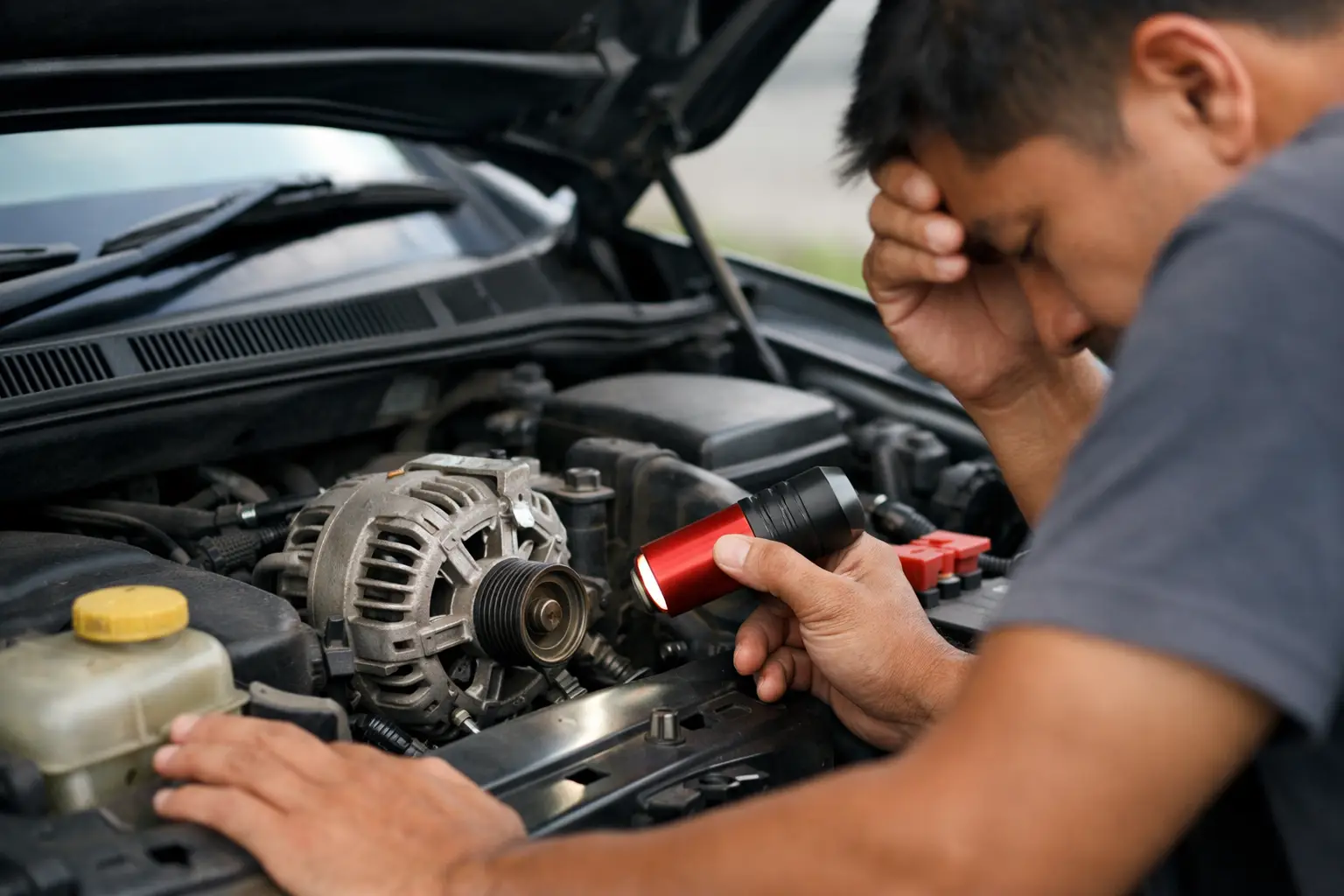
Your car starts fine one day, then the next it struggles, the dash lights up, and suddenly you are wondering whether it is the battery, the alternator, or something else entirely. When people search for alternator failure symptoms car problems are usually already affecting their day – late for work, stuck at home, or worried the vehicle will not restart after the school run.
The tricky part is that alternator faults often look like battery faults at first. The difference matters, because replacing a battery will not fix a charging problem. If the alternator is failing, your car may keep losing power no matter how new the battery is.
What the alternator actually does
The alternator keeps your vehicle’s electrical system running while the engine is on. It charges the battery and supplies power to things like the headlights, dash, radio, air conditioning controls, power windows and ignition system.
If it stops doing that properly, the car starts running off the battery alone. That battery only has a limited reserve. Once it drops too low, the vehicle may crank slowly, misbehave electrically, or stop altogether.
That is why alternator issues can go from minor warning signs to a no-start situation faster than many drivers expect.
Common alternator failure symptoms in a car
Some signs are obvious. Others are easy to brush off until the problem gets worse. If you notice more than one of the following, it is worth having the charging system tested properly.
Dim or flickering headlights
This is one of the most common alternator failure symptoms car owners notice first, especially when driving at night. Your headlights may seem weaker than usual, flicker at idle, or change brightness as you accelerate.
That happens because the alternator is not providing stable voltage. In some cases, interior lights and the dashboard may also pulse or dim at the same time.
Battery warning light on the dash
Many drivers assume the battery light means the battery itself has failed. Often, it is actually warning of a charging system problem. That could mean the alternator, wiring, belt, voltage regulator or battery connections.
The light should never be ignored just because the car is still running. Plenty of vehicles will continue driving for a short time before the battery runs flat.
Slow starting or repeated flat battery
If your vehicle needs jump-starting more than once, do not assume the battery is the only issue. A weak alternator may not be charging it properly between trips.
This is especially common if the car starts after a jump but goes flat again shortly after. That pattern usually points to a charging fault rather than a once-off battery discharge.
Electrical accessories acting strangely
Power windows moving slowly, the radio cutting out, the air conditioning blower weakening, dash lights flickering, or warning messages appearing for no clear reason can all point to voltage issues.
Modern vehicles rely heavily on stable electrical supply. When the alternator output drops, different systems may start behaving unpredictably. Some cars will even trigger multiple warning lights that seem unrelated.
Engine stalling while driving
A failing alternator can eventually affect ignition and fuel system operation. Once battery voltage drops too far, the engine may run rough, hesitate or stall.
This is one of the more serious symptoms because it can happen in traffic, at lights or during low-speed driving. If the car stalls and will not restart, the battery may already be too depleted to power essential systems.
Strange noises from the engine bay
Not every bad alternator makes noise, but some do. You might hear whining, grinding or a loose belt sound from under the bonnet.
Sometimes the internal bearings are wearing out. In other cases, the drive belt is slipping or the pulley is damaged. Noise alone does not confirm the alternator is faulty, but combined with charging symptoms, it is a strong clue.
Burning smell or hot electrical smell
An alternator that is overworking, overheating or shorting internally can produce a burnt smell. A slipping belt can also create a rubbery burning odour.
If you notice that smell together with warning lights or charging problems, it is best not to keep driving further than necessary.
Why alternator symptoms can be confused with battery problems
This is where many people get caught out. A flat or dying battery and a failing alternator often produce very similar signs – hard starting, clicking, dim lights and electrical issues.
The difference is in the cause. A battery stores power. The alternator replenishes it while you drive. If the alternator is weak, the battery slowly drains. That means the battery may test poorly even though it is not the original fault.
It also works the other way around. A battery with an internal fault can place extra strain on the charging system. That is why proper testing matters more than guessing.
What causes an alternator to fail
Alternators do wear out over time. Heat, vibration, age and daily use all take their toll. Internal components such as bearings, brushes, diodes and voltage regulators can fail gradually or all at once.
A loose or worn belt can also stop the alternator from charging correctly. Corroded battery terminals, damaged wiring or poor earth connections may create symptoms that feel like alternator failure even when the unit itself is still serviceable.
For that reason, replacing the alternator without testing the rest of the system is not always the smartest first move. Sometimes the fault is simpler and cheaper to sort out.
Can you keep driving with a failing alternator?
Sometimes, briefly. Often, it depends on how far the fault has progressed.
If the alternator is only charging weakly, you may still be able to drive for a short distance before the battery loses too much voltage. But there is no reliable countdown. It could be enough to get home, or it could leave you stranded at the next set of lights.
If headlights are dim, the battery light is on, and the car is showing multiple electrical faults, continuing to drive is risky. Night driving is even worse because lights, wipers and the fan draw more power.
For many drivers, the safer option is to get the vehicle tested where it is rather than push it until it stops.
How a proper diagnosis is done
A good diagnosis should go beyond a quick glance at the battery. The charging system needs to be tested under the right conditions, with voltage output, battery condition, belt condition and cable connections all checked.
In practical terms, that means confirming whether the alternator is undercharging, overcharging or not charging at all. Overcharging is less common, but it can happen and can damage the battery and electronics.
This is where a mobile specialist can save time. Instead of organising a tow or waiting at a workshop, you can have the fault assessed on-site at home, work or wherever the car is parked. For drivers searching Auto Electrician near me because the car may not make it to a shop, that convenience makes a real difference.
When to call for help
If your car has repeated flat batteries, dim lights, a battery warning light, or electrical faults that seem to come and go, it is time to get it checked. If the engine has already stalled or the vehicle will not restart, leave it parked and arrange testing.
Drivers in busy areas often put it off because they assume it will take half a day at a workshop. That is not always necessary. A mobile auto electrician can usually test the battery and alternator on-site, confirm the fault, and in many cases carry out the repair without you needing to leave your driveway or workplace.
That is especially useful if you rely on the car every day for commuting, school drop-offs or trade work. If you are in the western suburbs and searching Auto electrican Blacktown after your battery light comes on, getting someone out quickly can save a lot of stress.
At Ray’s Auto Electrical, the main focus is simple – find the real fault, fix what needs fixing, and get you moving again without the workshop runaround.
The smartest move when symptoms start
Alternator problems rarely improve on their own. What starts as occasional flickering lights or a slow crank can turn into a complete no-start at the worst possible time.
If something feels off with your car’s charging system, trust that instinct and get it tested early. It is usually faster, cheaper and far less frustrating to deal with an alternator issue before the battery is fully drained and the car leaves you stuck.