

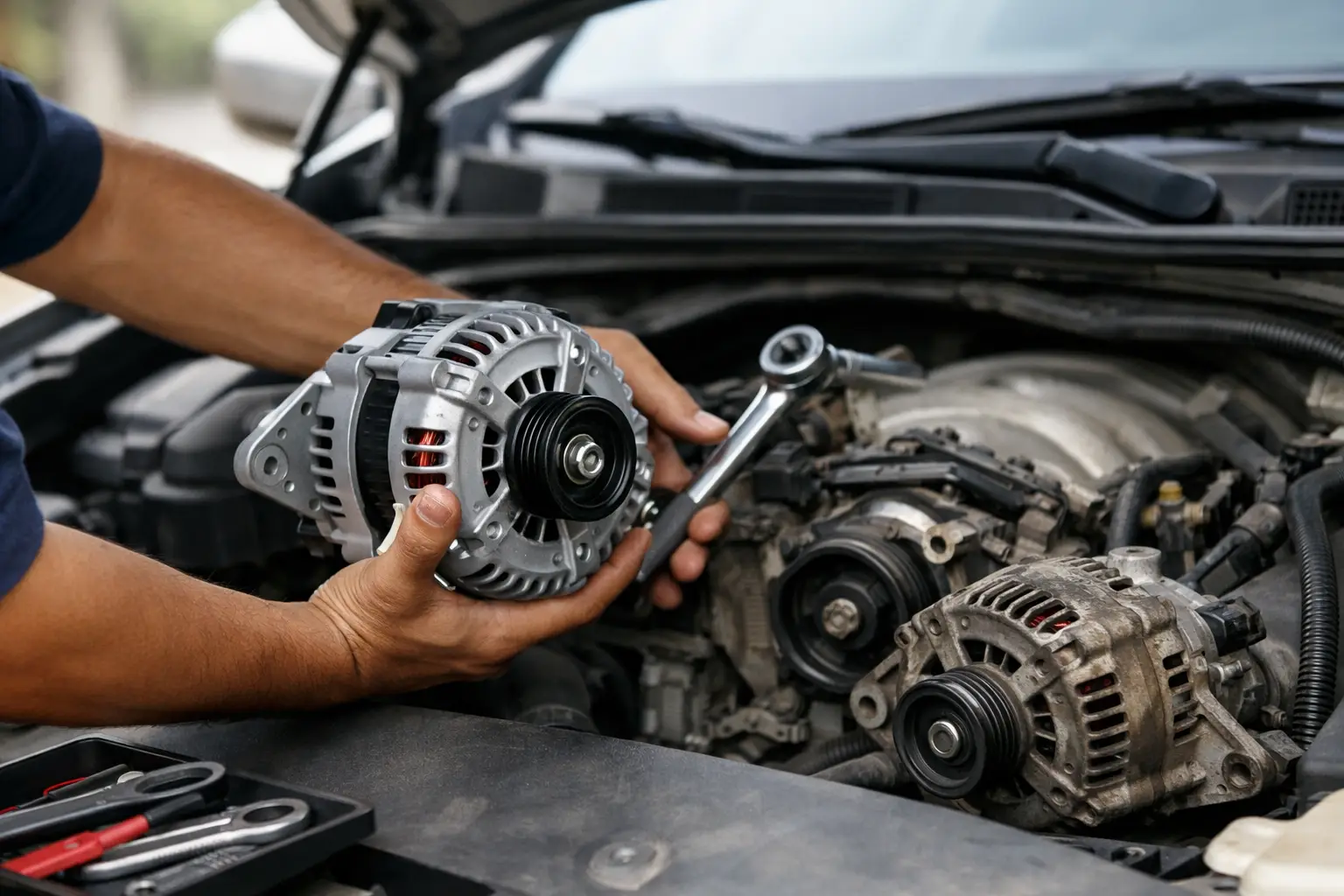
You usually do not get much warning before charging trouble turns into a car that will not start. One day the battery light flicks on, the headlights seem a bit weak, or the engine struggles to crank. The next day, you are stuck in a driveway, at work, or on the side of the road. That is why alternator replacement matters – not just as a repair, but as a way to avoid the bigger hassle of being stranded.
For most drivers, the alternator is out of sight and out of mind until something goes wrong. Its job is simple in theory. It keeps the battery charged and powers the vehicle’s electrical system while the engine is running. If it starts failing, the battery can drain quickly because the car is no longer being properly charged. Modern vehicles rely on stable voltage for everything from ignition and lighting to safety systems and accessories, so a weak alternator can create a wide range of symptoms that are easy to confuse with battery trouble.
What the alternator actually does
When your engine is running, the alternator produces electrical power and helps maintain battery charge. That means it supports the essentials, like starting and running, but also the everyday things you expect to work without thinking about them – headlights, air conditioning fans, power windows, dash displays, charging ports and more.
This is why alternator faults can feel inconsistent at first. A vehicle may still start in the morning but struggle later in the day. It may idle roughly with accessories on, or warning lights may come and go. In some cases, the battery gets blamed because the symptoms overlap. The battery may indeed be flat, but the real issue is that it was never being recharged properly in the first place.
Signs you may need alternator replacement
A failing alternator does not always announce itself in one obvious way. More often, it shows up through a pattern of electrical issues.
The most common sign is a battery warning light on the dash. Despite the label, that light often points to the charging system rather than the battery alone. Dimming headlights are another clue, especially if they change brightness with engine speed. You might also notice slow power windows, strange behaviour from the radio or dash cluster, or a vehicle that needs jump-starting more than once.
Sometimes there is noise involved. A worn bearing inside the alternator can create a whining or grinding sound. In other cases, the issue may come from the drive belt or tensioner rather than the alternator itself. That is why proper testing matters before replacing parts.
There are also cases where the car simply cuts out or refuses to restart after a short trip. Once the battery charge drops too low, the vehicle may not have enough electrical power to keep operating. At that point, alternator replacement may be needed urgently rather than at your convenience.
Why proper diagnosis comes first
Not every charging issue means you need a new alternator. A weak battery, damaged wiring, a poor earth, a blown fuse, a slipping belt or a faulty regulator can cause similar symptoms. Replacing the alternator without testing can waste time and money.
A proper diagnosis looks at the full charging system. Voltage output needs to be checked under different conditions, not just with the engine idling in the driveway. Battery condition also matters. If the battery has been repeatedly drained by a bad alternator, it may no longer hold charge properly even after the alternator is replaced.
This is where a mobile service can make things much easier. Instead of arranging a tow or trying to nurse the car to a workshop, the fault can often be tested on-site. For drivers searching Auto Electrician near me because the car is stuck at home or in a car park, that convenience can save a lot of disruption.
When alternator replacement is the right call
Alternator replacement is usually recommended when the unit has failed internally or is no longer delivering stable charging voltage. That can be due to worn brushes, failed diodes, bearing wear or regulator problems. In some vehicles, repairing individual components is technically possible, but replacement is often the more practical option for reliability and turnaround time.
It also depends on the age of the unit and the condition of related parts. If an alternator has done years of work and is now showing multiple signs of wear, fitting a quality replacement usually makes more sense than trying to patch it up. On the other hand, if testing shows the alternator is fine and the fault sits elsewhere, a good technician will tell you that too.
For daily drivers, timing matters. Waiting too long can leave you with a flat battery in an inconvenient place, and that often turns a manageable repair into a bigger interruption. If the vehicle is used for commuting, school runs or trade work, acting early is usually the safer option.
How much does alternator replacement cost?
The cost of alternator replacement varies depending on the vehicle, the part quality and how accessible the alternator is in the engine bay. On some cars, the job is fairly straightforward. On others, there may be limited access, extra labour and additional checks needed around the belt system or battery.
There is also a trade-off between cheaper parts and long-term reliability. A low-cost unit can look attractive upfront, but if it fails early or causes charging issues, the savings disappear quickly. For most vehicle owners, the better value is a quality part fitted properly, with testing carried out before and after installation.
If the battery has also been damaged by the charging fault, that may add to the overall cost. The same applies if there are related issues such as a worn belt or poor connections. A clear diagnosis and honest quote matter more than chasing the cheapest figure.
Can you keep driving with a bad alternator?
Sometimes, briefly. Often, that is a gamble.
A vehicle with a failing alternator may keep going until the battery charge is depleted. How long that takes depends on battery condition, electrical load and the nature of the fault. During the day, with minimal accessories running, you might get further. At night, with headlights, fans and demisters on, the battery can drain much faster.
The problem is that there is no reliable countdown. You may get twenty minutes, or you may get five. Once voltage drops too far, the vehicle can stall or fail to restart. If you are already seeing charging warnings or repeated flat battery problems, it is better to have it tested than assume you will make it where you need to go.
Choosing the right service for alternator replacement
Most people do not want a long lesson in vehicle electrics. They want the issue confirmed, the repair explained plainly and the car sorted without wasting half a day. That is why experience and convenience matter just as much as the part itself.
A good auto electrician will test the fault properly, explain whether the alternator is actually the cause, and let you know if the battery or other components have been affected. Mobile support is especially useful when the car is not safe or practical to drive. For drivers in busy areas of Sydney’s west, including those searching Auto electrican Blacktown, on-site help can be the difference between a simple repair and a towing bill plus lost time.
If you are comparing providers, ask whether they check the full charging system, whether they fit quality parts, and whether they can come to your home or workplace. Fast service is important, but so is getting the diagnosis right the first time.
After the replacement
Once the new alternator is fitted, the charging rate should be retested and the battery assessed again. If the old alternator has been undercharging for a while, the battery may need a proper charge or replacement depending on its condition. Ignoring that step can leave you thinking the repair has failed when the real issue is a battery that has already been weakened.
It is also worth keeping an eye on early warning signs in the weeks that follow. Dash lights, odd electrical behaviour or starting trouble should be checked promptly. Most of the time, a properly diagnosed and fitted alternator solves the problem cleanly. The key is not leaving the fault until the car gives you no choice.
If your vehicle is showing signs of charging trouble, getting it tested early is usually the cheapest and least stressful move. A small warning light today is much easier to deal with than a car that will not start tomorrow.