

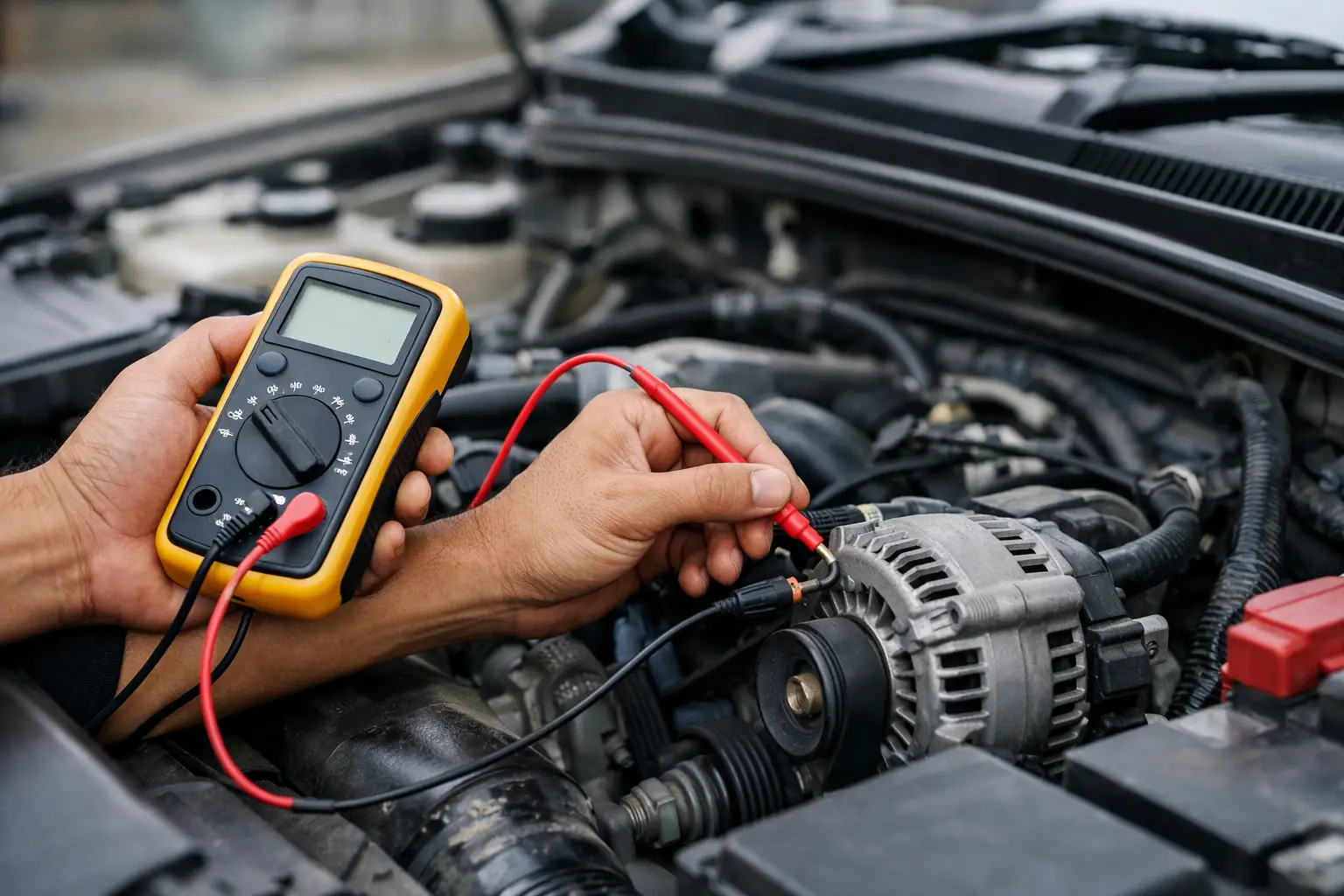
A car that starts one day and will not start the next is often blamed on the battery. Sometimes that is right. But if the battery keeps going flat, the warning light appears while driving, or the headlights dim at idle, the alternator needs checking too. Knowing how to test a car alternator with a multimeter can help you identify whether the charging system is doing its job before you are left stranded.
An alternator produces electricity while the engine runs. It powers the vehicle’s electrical systems and replenishes the battery after starting. When it fails, the vehicle may keep running for a short time on battery power, but it will eventually stop once the battery is discharged.
Before you test the alternator
You will need a digital multimeter, preferably one that can read DC voltage accurately. Park on level ground, select Park or neutral, apply the handbrake and keep loose clothing, jewellery and hands clear of belts, fans and other moving engine parts.
Start with a quick visual check under the bonnet. Look for loose or corroded battery terminals, a damaged alternator belt, obvious wiring damage or a burning smell. A slipping or broken belt can prevent a healthy alternator from charging properly. On some late-model vehicles, the alternator belt is not easy to inspect, so do not force covers or components out of the way.
It also helps to know the battery’s condition. A weak or damaged battery can give misleading test results, and a failed alternator can damage a battery through repeated deep discharge. The two parts work together, so neither should be assessed in isolation.
How to test a car alternator at the battery
The simplest and most useful test measures voltage directly across the battery terminals. Set your multimeter to DC volts, usually the 20V range on a manual-ranging meter. Connect the red probe to the positive battery terminal and the black probe to the negative terminal. Touch the metal terminals themselves, not dirty clamps or painted surfaces.
Check voltage with the engine off
With the engine switched off and the vehicle rested for at least a few minutes, a fully charged conventional 12V battery should usually read around 12.6V. A reading near 12.4V can still be serviceable, but below 12.2V indicates the battery is significantly discharged.
This first figure does not prove that the alternator is faulty. It simply gives you a starting point. If the battery is very flat, charge it correctly before drawing firm conclusions. Testing a charging system with a severely discharged battery can place extra strain on the alternator.
Check voltage at idle
Start the engine and check the reading again. In many vehicles, voltage should rise to roughly 13.8V to 14.7V at idle. That increase shows the alternator is supplying charge.
A reading that stays close to the engine-off voltage, such as 12.2V to 12.6V, suggests the battery is not being charged. Possible causes include a failed alternator, worn brushes, a faulty regulator, damaged cabling, poor earth connections, a blown charging fuse or a belt problem.
Do not assume a number slightly outside this range means immediate alternator replacement. Modern vehicles may use computer-controlled or smart charging systems that vary output according to battery condition, temperature and electrical demand. Some may briefly show lower voltage, particularly after start-up, then increase it under load or while driving.
Test with electrical accessories on
Leave the multimeter connected and switch on several normal electrical loads. Use the headlights, cabin fan, rear demister and air conditioning if fitted. Avoid adding every accessory at once if the battery is already weak.
The voltage may drop briefly, but a working system should generally recover and remain around the charging range. If it drops below about 13V and continues falling while the engine is running, the alternator may not be keeping up with demand.
Raise the engine speed gently to around 1,500 to 2,000 rpm and watch the meter. Voltage should remain stable rather than falling away. A reading above about 15V can be just as concerning as a low reading, as it may point to an overcharging fault or failed voltage regulator. Overcharging can boil a conventional battery, damage sensitive electronics and shorten battery life.
Watch for unstable voltage
Voltage that jumps around noticeably can indicate an intermittent fault. Loose battery terminals, a poor engine earth, damaged alternator wiring and internal alternator faults can all cause inconsistent charging. If the battery warning light flickers over bumps or when accessories are switched on, mention that detail when booking a diagnosis. It can save time locating the fault.
Symptoms that support an alternator fault
A multimeter result is valuable, but the symptoms matter as well. An alternator issue often shows up as a battery warning light on the dash, dim headlights at idle, slow or erratic power windows, an electrical burning smell, whining noises from the engine bay or repeated flat batteries.
A vehicle can still start normally with a failing alternator if the battery has enough stored charge. That is why a successful start does not rule out a charging issue. Conversely, a no-start condition is not automatically an alternator problem. Old batteries, poor terminal connections, starter motor faults and parasitic battery drains can produce similar symptoms.
If the warning light comes on while you are driving, reduce unnecessary electrical load and pull over safely when practical. Do not rely on the vehicle to keep going for a set distance. Once the battery is no longer being charged, it may lose enough power to stop the engine or affect essential systems without much warning.
Avoid the old battery-terminal test
You may hear advice to disconnect a battery terminal while the engine is running. Do not do it. Older vehicles could sometimes tolerate this test, but it is unsafe and can create voltage spikes that damage the alternator, engine computer, radio or other electronics.
A multimeter test is safer and more informative. Professional testing goes further by checking alternator output under load, voltage drop through positive and earth cables, battery health, starter draw and AC ripple. Excessive AC ripple can be a sign of failed alternator diodes, even when the basic voltage looks reasonable.
When the reading does not tell the full story
A healthy-looking voltage reading at the battery does not always mean the system is fault-free. A poor cable connection can allow the alternator to charge but prevent enough current reaching the battery. Likewise, an alternator may produce acceptable voltage with minimal load but fail once headlights, demister, air conditioning and other accessories are operating.
Some faults are intermittent. Heat, vibration and moisture can affect internal components or connections, so the issue may only occur after a drive. This is particularly frustrating when the battery light has appeared once, then disappeared by the time the vehicle is checked.
That is where an on-site electrical diagnosis is useful. A qualified technician can test the charging circuit where the vehicle is parked, at home or at work, rather than relying on one quick voltage check in the driveway.
When to call an auto electrician
If your alternator reading remains low, exceeds roughly 15V, fluctuates significantly, or the battery warning light is on, arrange a proper inspection. Continuing to drive can leave you stranded and may turn a straightforward repair into a damaged battery or electrical-system problem.
People searching Auto Electrician near me are usually looking for a quick answer to a vehicle that will not start or a warning light that cannot wait. For Sydney drivers, a mobile auto electrician can test the battery, alternator, wiring and related components at your location, then explain the fault clearly before repairs are carried out.
If you have searched for Auto electrician Blacktown, make sure the technician checks the whole charging system rather than replacing parts based on symptoms alone. At Ray’s Auto Electrical, the focus is on practical on-site diagnostics so you can get a reliable answer without the hassle of organising a workshop visit or tow.
A multimeter gives you a useful first check, but trust what the vehicle is telling you. Repeated flat batteries, warning lights and unstable electrical accessories are worth acting on early, while the car can still be tested safely where it sits.