

A battery can look perfectly normal right up until the morning it leaves you stuck in the driveway, car park or at a job site. Slow cranking, dim headlights and a clicking sound when you turn the key are all early warnings. Knowing how to test car battery condition can help you act before a flat battery interrupts your day.
You do not need to be an auto electrician to carry out a few basic checks. A proper diagnosis, however, looks beyond the battery itself. The alternator, battery terminals, cables and parasitic electrical drains can all cause similar starting problems.
Start with the obvious battery checks
Park on level ground, switch the ignition off and remove the key. If your battery is fitted under the bonnet, allow the engine bay to cool first. Wear eye protection if you are inspecting an older battery or one that shows signs of damage.
Look closely at the battery case. Swelling, cracks, leaks or a strong rotten-egg smell mean the battery should not be charged or jump-started repeatedly. It needs professional attention and safe replacement. Check the terminals as well. White, blue or green corrosion can prevent a solid connection, even when the battery has enough charge.
The clamps should be tight enough that they do not move by hand. If they are loose or corroded, clean them carefully with the correct battery terminal cleaner, then reconnect them firmly. Always avoid allowing a metal tool to bridge the positive and negative terminals.
Also consider the battery’s age. Most vehicle batteries last around three to five years in normal conditions, although Sydney heat, frequent short trips, heavy accessory use and stop-start driving can shorten that lifespan. The date code or sticker on the battery may give you a useful clue.
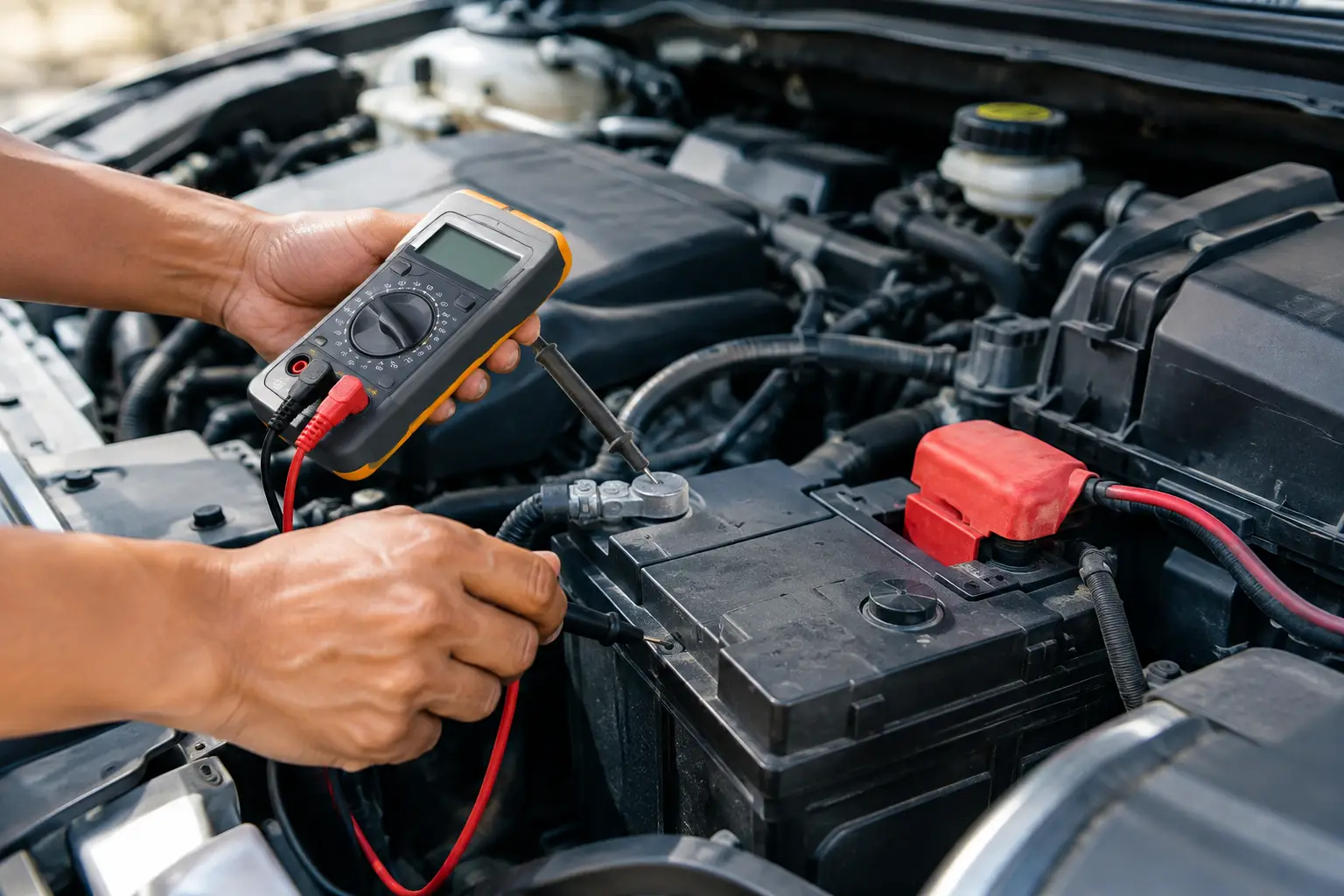
How to test car battery voltage with a multimeter
A digital multimeter gives a quick indication of battery state of charge. It is useful, affordable and more reliable than judging a battery by whether the dashboard lights come on.
Set the multimeter to DC voltage, usually marked as V with a straight line. Connect the red probe to the positive battery terminal and the black probe to the negative terminal. Test the battery after the vehicle has been switched off for at least a few hours where possible. Testing immediately after a drive can give a falsely high reading, known as a surface charge.
For a standard 12-volt battery, use these readings as a general guide:
- Around 12.6 to 12.8 volts usually indicates a fully charged, healthy battery.
- Around 12.4 volts indicates a partly charged battery that should still start most vehicles.
- Around 12.2 volts means the battery is low and should be charged and retested.
- Below 12.0 volts suggests a heavily discharged battery or a battery with an internal fault.
Voltage alone does not prove a battery is healthy. A weak battery can show a reasonable voltage with no load, then drop away when the starter motor demands high current. That is why a load test or conductance test is the better option when the vehicle has intermittent starting trouble.
Check voltage while starting the vehicle
Leave the multimeter connected and have someone start the car while you watch the reading. During cranking, a healthy battery will generally stay above about 9.6 volts. A significant drop below this figure can point to a weak battery, poor connections or a starter motor drawing too much current.
This test has limits. Modern vehicles can have complex electrical systems, and some batteries are difficult to access. If your vehicle has a stop-start system, AGM or EFB battery, it is especially worth having the battery tested with equipment designed for that battery type. Fitting the wrong battery or skipping battery registration on some late-model vehicles can create further faults.
Test the alternator as well
Many batteries are replaced when the actual problem is the charging system. If the alternator is not replacing the power used to start and run the vehicle, even a new battery will soon go flat.
With the engine running, test across the battery terminals again. Most conventional charging systems should read roughly 13.7 to 14.7 volts. Readings below this range may indicate an alternator, drive belt, wiring or regulator issue. A reading that is consistently too high can overcharge the battery and damage it over time.
Turn on electrical loads such as headlights, air conditioning fan and rear demister, then check again. The voltage should remain stable in the normal charging range. A small variation is normal, particularly in smart charging vehicles, but flickering lights, a battery warning light or a voltage that falls steadily deserve proper diagnosis.
Do not disconnect a battery terminal while the engine is running to test the alternator. This old shortcut can create voltage spikes and potentially damage sensitive electronics, including the engine control unit, radio or dash displays.
Signs the problem may not be the battery
A battery test is only one part of tracking down a no-start issue. If the headlights are bright but the engine clicks once or does not turn over, the starter motor, starter relay or a poor earth connection may be at fault. If the battery repeatedly goes flat after sitting overnight, there may be an electrical drain caused by an accessory, faulty module, glovebox light or wiring issue.
Short trips can also be the cause. Starting an engine takes a large amount of battery power, and a five-minute drive may not give the alternator enough time to replace it. This is common for vehicles used mainly for school runs, local errands or occasional weekend driving.
On the other hand, a battery that goes flat after a long drive is less likely to be suffering only from short-trip use. That situation makes alternator performance, loose terminals and battery condition more likely suspects.
When a professional battery test is the smarter option
If your vehicle starts inconsistently, do not wait until it fails completely. A professional battery and charging test measures more than resting voltage. It can assess cold cranking capacity, internal battery resistance, charging output and voltage drop through key cables. These results help identify whether the battery needs replacement or whether another electrical fault is causing the trouble.
This matters when you rely on your car for work, family commitments or daily commuting. Replacing a battery unnecessarily costs money, while ignoring a faulty alternator can leave you stranded again soon after.
A mobile auto electrician can test the system where the car is parked, whether that is at home, work or on the roadside. There is no need to organise a tow or gamble on whether the vehicle will make it to a workshop. Ray’s Auto Electrical provides on-site battery and alternator testing across Sydney, with practical advice on the repair or replacement that actually suits the fault.
What to do if the battery is flat now
A jump-start may get the engine running, but it is not a diagnosis or a lasting fix. If you jump-start the vehicle, drive it long enough for a basic recharge only if it is safe to do so, then arrange a battery and charging-system test. Avoid switching the engine off in an inconvenient location until you know why the battery went flat.
If the battery case is damaged, leaking or swollen, do not jump-start it. Keep flames and sparks away, and call for assistance. Likewise, repeated jump-starts can strain a weak battery and may hide an alternator fault.
When you need prompt help, searching “Auto Electrician near me” can connect you with a mobile specialist rather than leaving you to arrange a workshop visit. For drivers in the western suburbs, the search term “Auto electrician Blacktown” is also commonly used when looking for local battery and starting-system assistance.
A five-minute voltage check can give you an early warning, but the best time to arrange a proper test is before the next early start, school run or work shift depends on a battery that is already showing signs of giving up.