

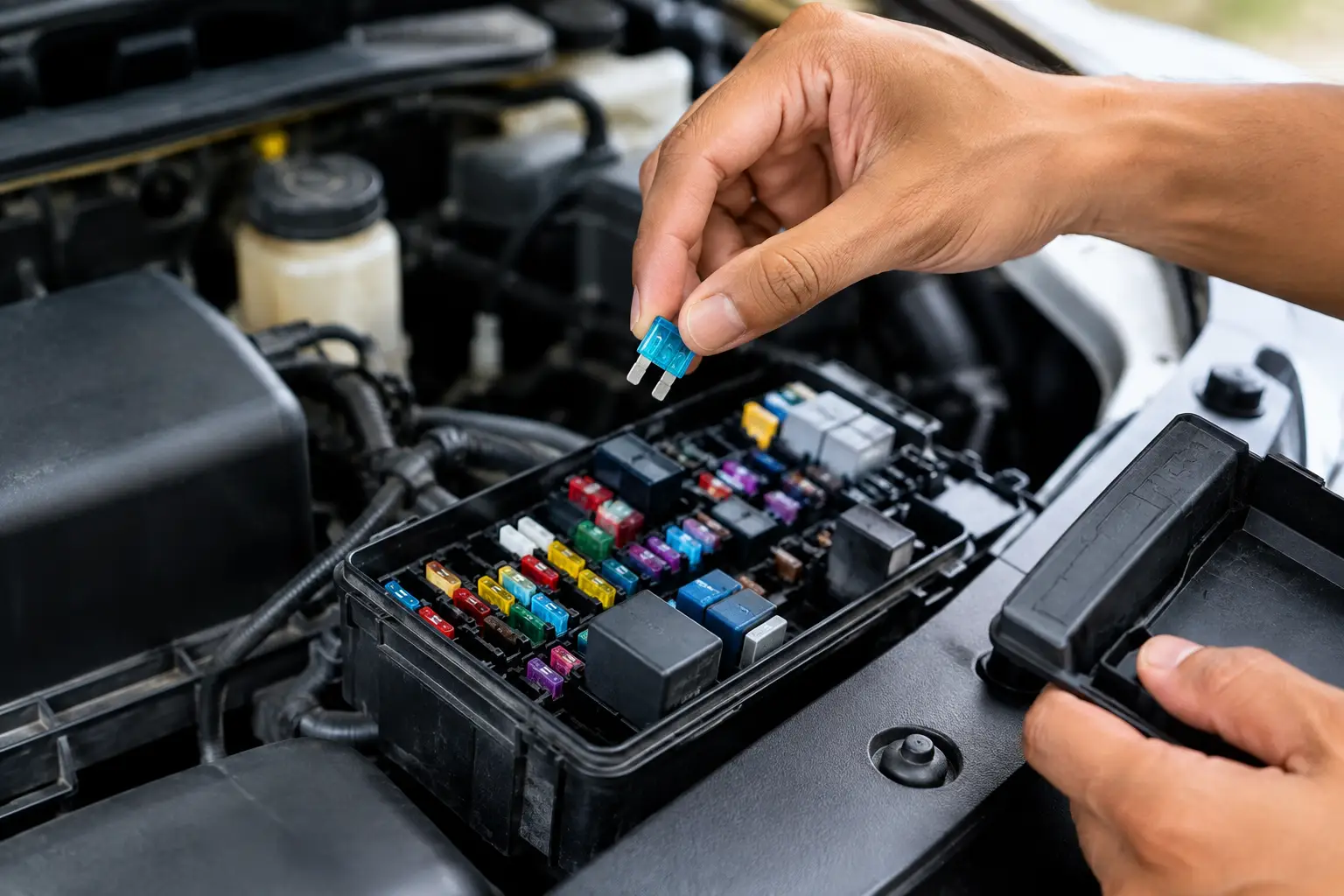
A power window that suddenly stops, a radio with no sound, or a cabin light that will not switch on can often come down to one small part: a fuse. Knowing how to identify blown fuses can help you narrow down a minor electrical issue, avoid replacing the wrong component, and explain the fault clearly when you call an auto electrician.
A fuse is designed to protect a vehicle circuit. When too much electrical current flows through that circuit, the fuse breaks internally before the wiring, switch, control module or accessory can be damaged. That protection is useful, but a blown fuse is often a symptom rather than the whole problem. Replacing it may restore power, or it may blow again if there is an underlying fault.
What a blown fuse can look like
Most modern cars use blade fuses, which are small plastic pieces with two metal terminals. They are usually colour-coded by amp rating. You may see red, blue, yellow, clear or green fuses in the fuse box, although colours can vary between vehicle makes.
On top of the fuse is a small clear window. Inside, a thin metal strip connects the two terminals. A healthy fuse has an unbroken strip. A blown fuse generally has a visible gap in that strip, or the metal may look burnt, melted or darkened.
This quick visual check is useful, but it is not foolproof. Fine cracks and internal breaks are not always easy to spot, particularly in poor light. A fuse can also look normal but fail under load. If you are unsure, testing it with a test light or multimeter is more reliable.
Start with the symptom, not the fuse box
Before pulling fuses out, work out exactly what has stopped working. If only one item has failed, such as the cigarette socket, rear wiper or one headlight, the relevant fuse may be clearly labelled in the vehicle handbook or on the fuse box cover.
If several unrelated electrical systems stop working together, the cause may be a shared fuse, relay, battery connection, earth fault or control module issue. For example, a flat battery can make electrical accessories behave strangely without any fuse actually being blown.
Take note of when the fault occurs. Does the fuse blow as soon as you turn the ignition on? Only when you use the air conditioning? When towing a trailer, using a UHF, or charging a mobile? Those details help identify whether an accessory or a particular circuit is overloaded.
How to identify blown fuses safely
Park on level ground, switch the ignition off and remove the key or keep the key well away from push-button start vehicles. Allow any hot engine components to cool if you need to check the fuse box under the bonnet.
Most vehicles have at least two fuse boxes. One is commonly under the dashboard, around the driver’s footwell or behind a side panel. Another may be located in the engine bay. Some utes, four-wheel drives and larger vehicles also have additional fuse panels for trailer wiring, accessories or rear electrical systems.
Use the diagram on the fuse box cover or in the owner’s manual to find the correct circuit. A plastic fuse puller may be clipped inside the fuse box. If not, use needle-nose pliers carefully, gripping the plastic body rather than forcing the terminals. Avoid using metal tools around exposed electrical points.
Once removed, hold the fuse up to the light and inspect the metal strip. If the strip is broken, the fuse has blown. If it appears intact but you still suspect a fault, test it rather than guessing.
Testing a fuse with a multimeter
Set your multimeter to continuity or resistance. With the fuse removed, touch one probe to each terminal. A good fuse should show continuity or very low resistance. A blown fuse will show no continuity, often displayed as OL or a similar reading depending on the meter.
You can also test many fuses while they remain installed by using the small test points on top of the fuse. With the circuit powered where appropriate, a test light or multimeter should show power at both test points. Power on one side only usually means the fuse is blown.
Testing in place saves time, but it depends on the circuit being energised. Some circuits only receive power with the ignition on, while others are controlled by the body control module and may not operate in every key position. If readings are unclear, do not keep probing at random. It is better to have the circuit diagnosed properly.
Always match the fuse rating
If you find a blown fuse, replace it only with one of the same amp rating. The rating is printed on top of the fuse and is also listed in the vehicle manual. Never fit a higher-rated fuse because it is the only spare available.
A larger fuse may allow too much current through the circuit before it fails. That can overheat wiring and damage expensive electrical components. Never bridge a fuse with wire, foil or any improvised material. It may seem like a quick fix, but it removes the protection the fuse is there to provide.
A lower-rated fuse is safer than fitting a larger one, but it may blow during normal operation. The right answer is always the correct rating for that specific circuit.
When replacing the fuse is enough
Sometimes fuses blow for a straightforward reason. A phone charger may have failed internally, a 12V accessory socket may have been overloaded, or moisture may have caused a temporary short around a trailer plug. If you remove the faulty accessory, fit the correct replacement fuse and the problem does not return, the issue may be resolved.
Check the circuit carefully before assuming it is fixed. Turn the relevant system on and off a few times, and watch for flickering, heat, burning smells or repeated fuse failure. If the replacement fuse holds and the item works normally, there is usually no need to disturb other fuses.
When a blown fuse needs professional diagnosis
A fuse that blows again is telling you something. Repeated failures can be caused by damaged wiring, water entry, a shorted motor, a faulty relay, an incorrectly installed accessory or a component drawing more current than it should.
This is especially common with power windows, radiator fans, air conditioning blowers, trailer wiring, aftermarket sound systems, dash cams and driving lights. Accessories can be excellent additions to a vehicle when installed correctly, but poor connections or undersized wiring can create intermittent faults that are difficult to find without the right equipment.
Do not continue replacing fuses to see if one eventually holds. Each failure can point to a live short circuit, and repeated testing may cause further damage. A qualified auto electrician can test the circuit, inspect wiring and connections, and identify the cause without replacing parts unnecessarily.
If your car will not start, lights are failing, or you have lost power to a safety-related system, arrange assistance rather than driving with an electrical fault. Ray’s Auto Electrical provides mobile fault diagnostics across Sydney, so many issues can be checked where your vehicle is parked – at home, work or on site.
A quick check before calling for help
If it is safe to do so, have your vehicle make, model and year ready, along with the exact electrical item that has stopped working. Mention whether the fuse has blown once or repeatedly, what rating it is, and whether any accessories were recently fitted. A photo of the fuse box label can also be helpful.
Searching “auto electrician near me” can bring up plenty of options, but choose someone who can diagnose the reason behind the failure, not simply replace the fuse. If you need an auto electrician in Blacktown or elsewhere in Sydney’s western suburbs, a mobile service can save the hassle of organising a tow or losing a day at a workshop.
A blown fuse may be a simple fix, but it is also your vehicle’s warning that a circuit needs attention. Check it calmly, replace it only with the correct rating, and treat any repeat failure as a reason to get the wiring properly inspected before a small problem becomes a bigger one.