

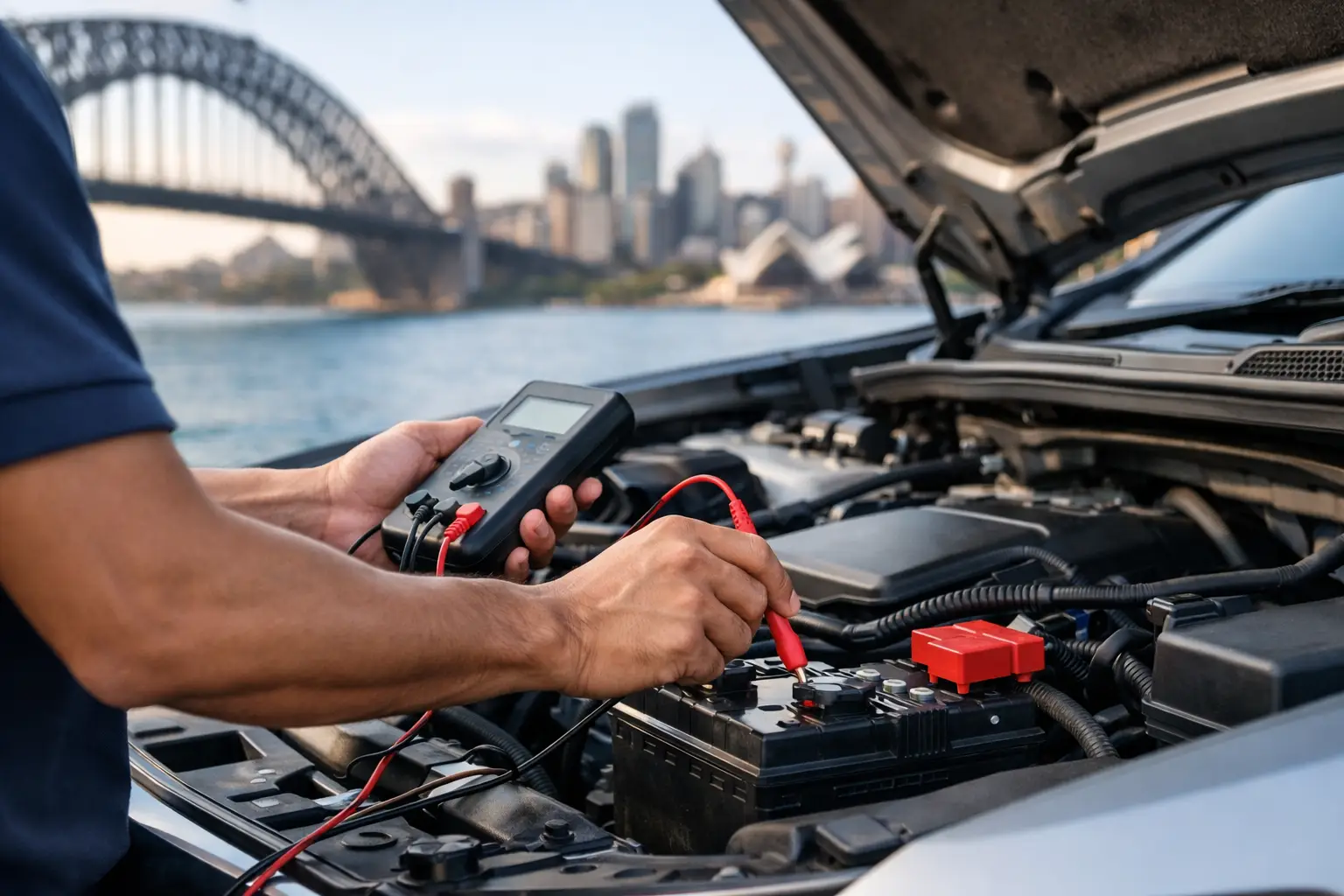
A battery can seem fine at 3 pm and leave you stranded outside the shops at 7 am the next morning. Slow cranking, dim headlights and dashboard warning lights are easy to dismiss, but they often point to a battery that is losing capacity or a charging fault that needs attention. This car battery testing guide explains the basic checks you can make safely and when it is better to call a qualified auto electrician.
Signs your battery needs testing
Most batteries do not fail without warning. The engine may turn over more slowly than usual, especially after the car has sat overnight. Your interior lights may dim when starting, the clock or radio settings may reset, or you may need a jump-start more than once.
A battery warning light does not always mean the battery itself is faulty. It can also indicate an alternator, drive belt, wiring or connection issue. That is why testing matters. Replacing a battery without checking the charging system can leave you with the same problem again.
Battery age is another useful clue. In Sydney conditions, many car batteries last around three to five years, although heat, short trips, stop-start driving and accessory use can shorten that lifespan. If your battery is approaching this age, have it checked before it becomes an inconvenient no-start.
Car battery testing guide: start with a visual check
Before using any tester or multimeter, switch the ignition off, remove the key and make sure the vehicle is in park or neutral with the handbrake applied. Let the engine bay cool if the vehicle has just been driven.
Open the bonnet and inspect the battery case. Look for swelling, cracks, leaks or acid residue around the terminals. A swollen battery should not be charged or handled unnecessarily. It needs professional attention and safe replacement.
Check that the battery terminals are tight. Loose clamps can cause intermittent starting problems that feel exactly like a flat battery. White, blue or green corrosion around the terminals can restrict electrical flow as well. Light corrosion can be cleaned carefully with the correct equipment, but always avoid allowing metal tools to bridge the positive and negative terminals.
Also check that the battery is properly secured in its tray. A battery that moves around can suffer internal damage, particularly on rough roads or in work vehicles and utes.
Check the battery voltage with a multimeter
A digital multimeter provides a quick indication of battery state, but it does not tell the whole story. A battery can show acceptable voltage with no load and still collapse when asked to start the engine.
Set the meter to DC volts, typically the 20V range. Touch the red probe to the positive terminal and the black probe to the negative terminal. For the most useful resting voltage reading, test the car after it has been switched off for several hours.
A healthy, fully charged 12V battery will usually read about 12.6V. A reading around 12.4V suggests it is partly charged. Around 12.2V is low, while 12.0V or below usually means the battery is significantly discharged or may have a fault.
These numbers are a guide, not a final diagnosis. A low reading may mean the battery needs charging because the vehicle has not been driven enough. It may also mean the alternator is not recharging it properly, there is an electrical drain, or the battery can no longer hold charge. The battery type matters too. AGM and start-stop batteries have different requirements from conventional flooded batteries and should be tested with suitable equipment.
Test the charging system after starting
If the engine starts, test the voltage again with the engine idling. In many vehicles, a healthy charging system will show roughly 13.8V to 14.7V. Modern smart charging systems can vary their output depending on battery condition, temperature and electrical demand, so a single reading is not always enough.
Turn on a few normal electrical loads, such as headlights, air conditioning fan and rear demister, then check whether voltage remains stable. If it stays low, drops sharply or rises excessively, the issue could be the alternator, voltage regulator, wiring, earth connection or drive belt.
Do not use the old method of disconnecting a battery terminal while the engine is running. It can create voltage spikes and damage sensitive vehicle electronics. A proper charging-system test is safer and gives a far more useful result.
Why a load test gives a clearer answer
Voltage tells you how charged a battery appears. A load test checks whether it can actually deliver the current needed to start the engine. This is especially useful when a vehicle starts sometimes but not every time.
A professional battery tester measures the battery’s cold cranking amps, internal resistance and overall health. It can show whether the battery is simply flat and recoverable, weak from age, or internally damaged. The test is quick, but its value is in avoiding guesswork.
A battery that passes a voltage check but fails under load will often cause slow cranking, repeated clicking or a complete no-start. Recharging it may provide a temporary improvement, but it is unlikely to be dependable for long.
Consider what is draining the battery
If a battery goes flat repeatedly, replacing it may not solve the cause. Some drains are simple, such as a cabin light, boot light or accessory left on. Others are harder to find, including a faulty relay, damaged wiring, aftermarket audio equipment, dash cam wiring, or a module that fails to go into sleep mode.
Short trips can be part of the problem too. Starting an engine takes a large amount of energy, and a five-minute drive may not replace it, particularly with air conditioning, headlights and mobile charging in use. This is common for cars used mainly for school runs or local errands.
Parasitic draw testing requires the vehicle to be checked after its systems have powered down. It is not a job to rush with a basic meter, as an incorrect setup can blow the meter fuse or affect vehicle systems. A qualified mobile auto electrician can test the drain, battery and alternator together to find the real fault.
When to call an auto electrician
Book a professional battery and charging test if the battery warning light is on, the vehicle needs regular jump-starts, the battery is swollen, or the engine cranks slowly despite a recent battery replacement. It is also worth arranging a check before a long road trip, especially if the battery is more than three years old.
For drivers searching “Auto Electrician near me”, the practical benefit of a mobile service is simple: testing can be completed where the vehicle is parked, at home, work or on site. There is no need to risk driving a car with an unreliable charging system or organise a tow for a fault that can be diagnosed on location.
If you are looking for an “Auto electrician Blacktown” service, make sure the technician tests more than battery voltage. A proper diagnosis should consider battery condition, alternator output, terminals, cables, earth points and possible electrical drains before recommending replacement.
Ray’s Auto Electrical provides on-site battery, alternator and electrical fault testing across Sydney, including the Western Suburbs. Clear testing first means you can make a decision based on the condition of your vehicle, rather than replacing parts unnecessarily.
A battery test takes little time compared with the disruption of being stranded. If your car has started to crank slowly or shown even one warning sign, arrange a check while it still starts – not after it leaves you stuck.