

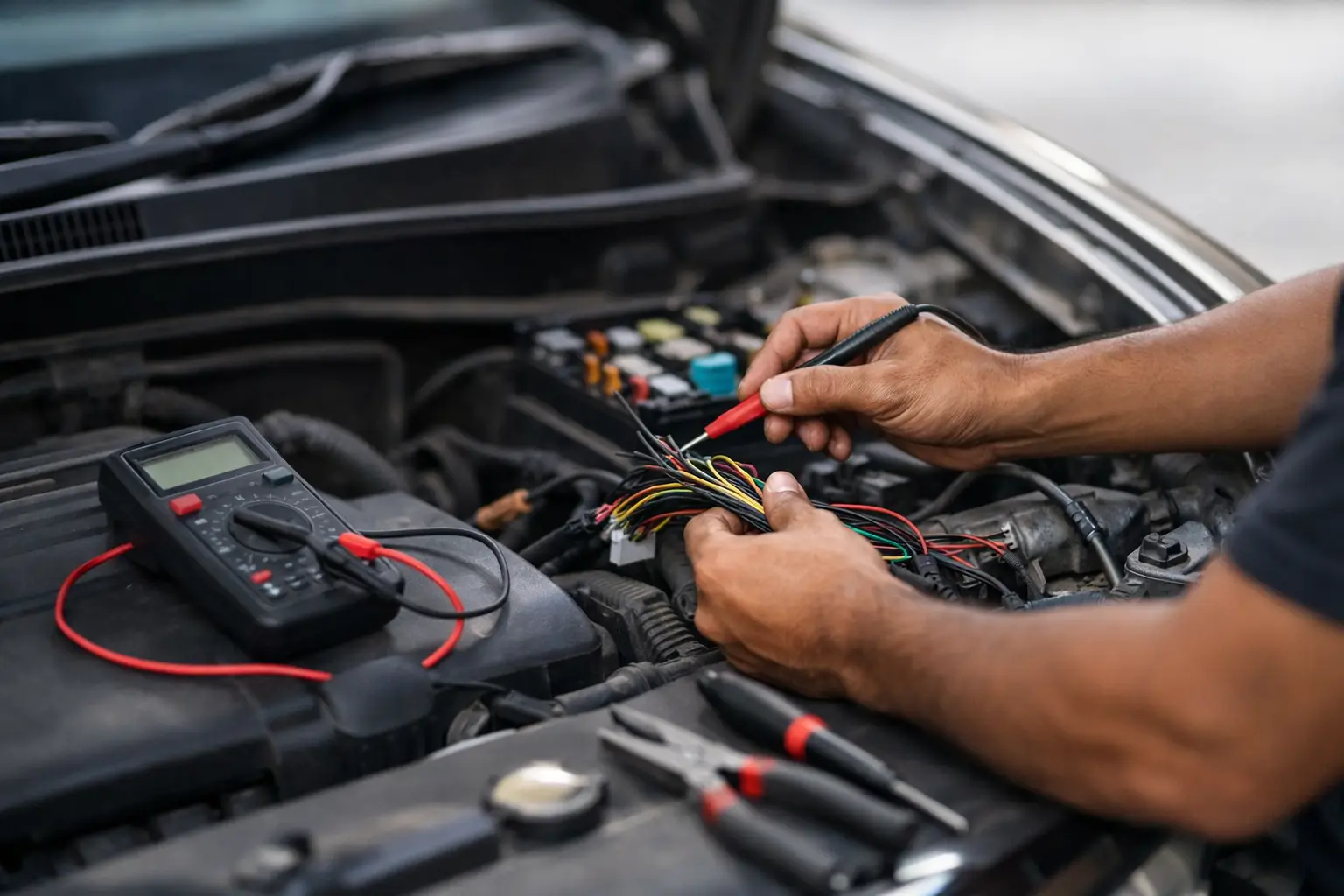
A car that starts one day and refuses the next, headlights that flicker for no clear reason, or a radio that cuts in and out over every bump – these are the sort of faults that often come back to wiring. If you are wondering how to diagnose car wiring faults, the main job is not guessing. It is narrowing the problem down safely and checking the circuit in a logical order.
Wiring faults can look dramatic, but many come from a small issue such as a loose earth, corrosion in a connector, damaged insulation, or a fuse contact that is not making clean connection. The challenge is that one fault can affect more than one system, especially in modern vehicles where circuits overlap and control modules rely on stable voltage.
Why wiring faults are often misdiagnosed
A lot of electrical problems get blamed on the wrong part. Someone replaces a battery because the car is hard to start, but the real issue is voltage drop through a corroded cable. Another driver changes globes repeatedly when the actual fault is a poor earth point behind the light assembly.
That is why proper diagnosis matters. It saves money, avoids swapping good parts, and gives you a better chance of fixing the problem properly the first time. In some cases, a wiring issue is also a safety problem, especially if it affects lighting, starting, charging, or anything that could short out and overheat.
Start with the symptom, not the whole car
The easiest way to approach electrical faults is to focus on one affected system first. Ask a few simple questions. What has stopped working? Does it fail all the time or only sometimes? Did the problem start after rain, a flat battery, accessory installation, or recent repairs?
Intermittent faults are common with wiring. If the issue happens only when turning, braking, hitting bumps, or using another accessory, that points toward movement, vibration, or shared power and earth connections. If several unrelated items fail together, look for a common fuse, relay, earth, or main feed.
How to diagnose car wiring faults safely
Before you touch anything, make the job safe. If you are checking exposed wires, burnt connectors, or battery cables, switch the vehicle off. If you are disconnecting plugs or removing trim near airbags or sensitive electronics, it is safer to isolate the battery first. On newer vehicles, you also need to be careful not to create extra faults by unplugging modules the wrong way.
You do not need a workshop full of gear for basic checks. A torch, a decent multimeter, and a wiring diagram help a lot. Even without a wiring diagram, you can still learn plenty by inspecting the power source, fuse, earth, connector, and load in that order.
Check the basics before chasing hidden faults
Most wiring diagnosis starts with simple things that are easy to miss. Battery condition comes first. Low system voltage can create strange behaviour across the car, from warning lights to non-start faults. Make sure the battery terminals are clean, tight, and free from heavy corrosion.
Then look at fuses properly. Do not just glance at the top. A fuse can appear fine but have poor contact at the blades or in the holder. If a fuse keeps blowing, never fit a larger one. That usually means there is a short circuit or a component drawing too much current.
Earth points are another big one. A bad earth can cause dim lights, erratic gauges, slow cranking, sensor issues, and faults that seem to move around the vehicle. Check for loose bolts, rust, white or green corrosion, and signs of heat around the connection.
Visual inspection still matters
When people think electrical diagnosis, they often picture complex testing. In reality, a careful look can solve a surprising number of faults. Follow the wiring loom as far as you can and check for crushed sections, rubbing against metal brackets, melted insulation, rodent damage, and joins wrapped in old tape.
Pay close attention to areas that flex or get wet. Door jambs, tailgate looms, trailer plugs, engine bay corners, battery terminals, and wiring near aftermarket accessories are common problem spots. If a dash cam, stereo, spotlights, or UHF has been added at some point, poor joins or overloaded circuits can easily cause trouble later.
Use voltage testing, not guesswork
If the circuit looks intact, the next step is testing for voltage. This is where a multimeter helps. You want to know whether power is reaching the component and whether the earth side is good enough to complete the circuit.
For example, if a headlight is not working, test for battery voltage at the connector with the switch on. If voltage is present but the light still does not work, the problem may be the globe, connector, or earth. If no voltage is present, work backwards through the fuse, relay, switch, and wiring until you find where power stops.
Voltage drop testing is especially useful and often overlooked. A cable can look fine from the outside but still have resistance inside from corrosion or broken strands. If a starter motor or fuel pump is getting less voltage than it should under load, the fault may be in the cable or connection rather than the part itself.
Common signs of specific wiring problems
Different faults tend to leave different clues. A dead short often blows a fuse quickly. A high resistance fault may cause dim operation, heat build-up, or intermittent performance. A poor earth often makes one component affect another, such as indicators flashing oddly when brakes are applied.
Burning smell, melted plastic, and hot connectors usually point to excess current or resistance. Water-related faults may show up after heavy rain, a car wash, or condensation. Green corrosion in connectors is a strong sign moisture has been inside for a while.
If the issue comes and goes, gently moving sections of loom while the system is operating can sometimes expose the fault. You need to be careful doing this, but it can reveal a broken wire inside insulation or a loose terminal that only fails with movement.
When a scan tool helps and when it does not
On newer vehicles, scan tools are useful, but they are not magic. A fault code may tell you a sensor signal is missing or out of range, but it does not always mean the sensor itself has failed. The real issue could be damaged wiring, low reference voltage, poor earth, or connector corrosion.
That is why fault codes need to be read alongside physical testing. Replacing parts based on a code alone is one of the most common ways people waste money on electrical problems.
Aftermarket accessories can complicate things
A lot of wiring faults begin after accessories are installed badly. Extra lighting, sound systems, electric brakes, reversing cameras, and mobile chargers can all create issues if wiring has been tapped into the wrong circuit or joined poorly.
If the fault started after an accessory was fitted, inspect that work first. Scotch locks, twisted joins, undersized cable, and missing fuse protection are red flags. Even if the accessory itself still works, it may be affecting the original vehicle wiring around it.
This is one reason people often search Auto Electrician near me when a problem starts affecting daily use. Once wiring has been altered, diagnosis can get time-consuming without the right test equipment and experience. The same applies if you need an Auto electrican Blacktown or anywhere across Sydney and want someone to trace the issue on-site rather than organising a tow.
When to stop and call a professional
Some faults are reasonable for a car owner to check. Loose battery terminals, obvious fuse issues, and visible corrosion are a fair starting point. But if you are dealing with repeated blown fuses, no-start conditions, burnt wiring, module communication faults, or anything involving airbag, ABS, or engine management circuits, it is usually better to hand it over.
Electrical diagnosis is often less about replacing parts and more about knowing what test to do next. A qualified mobile auto electrician can test live circuits, perform voltage drop checks, trace shorts, inspect accessory wiring, and repair damaged sections properly at your location. That is often faster and cheaper than replacing parts one by one and hoping the fault disappears.
A good repair also matters as much as the diagnosis. Temporary joins, household connectors, or tape-only fixes rarely last in a vehicle that deals with heat, moisture, vibration, and road grime every day.
If you remember one thing, make it this: the cleanest way to diagnose wiring faults is to follow the circuit step by step and let the testing tell the story. The fault is usually smaller than it first appears, but finding it properly makes all the difference.