

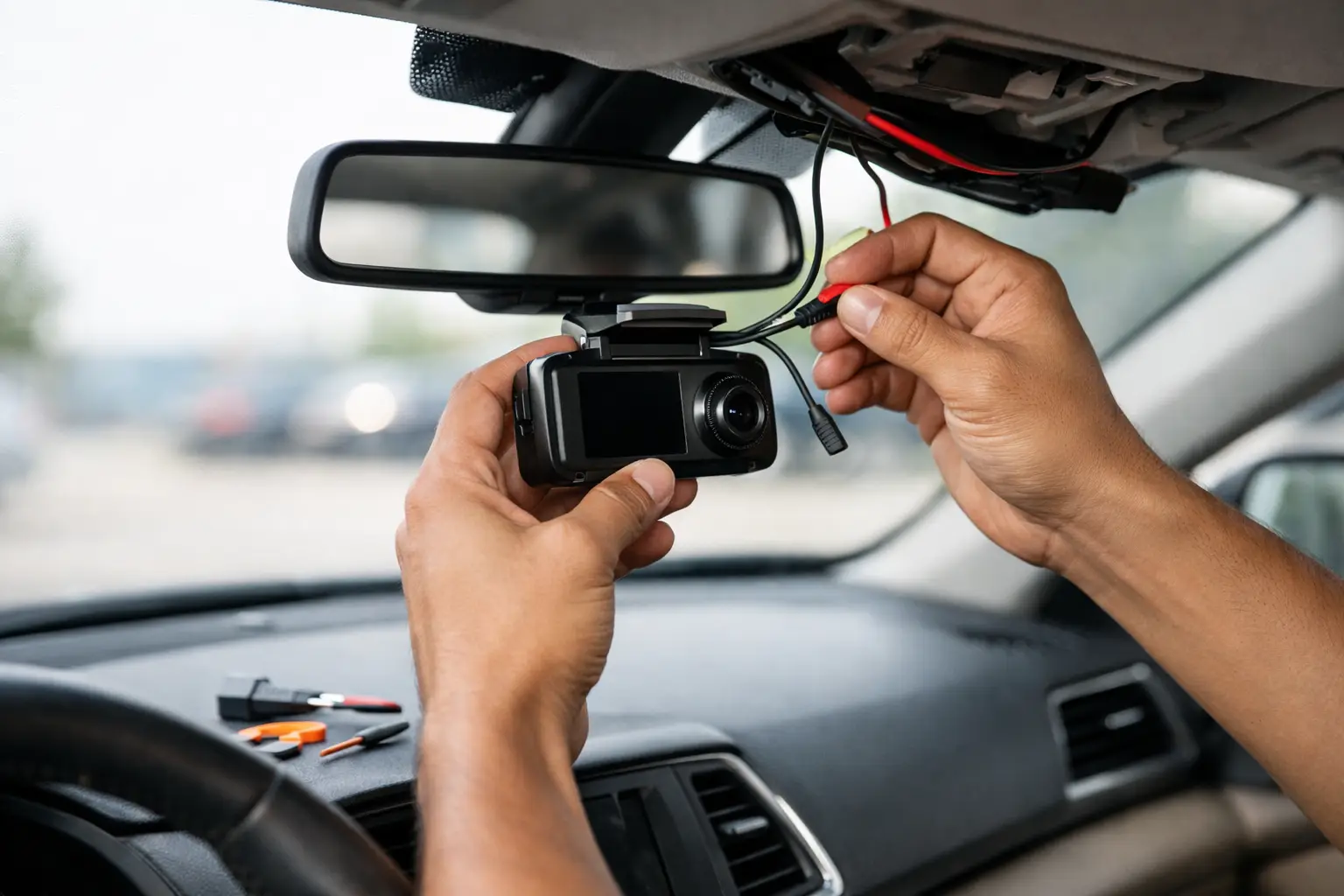
A dash cam is most useful when it is ready to record every trip, not when its power lead is hanging from the windscreen or has fallen out of the 12V socket. This dash cam hardwire installation guide explains what is involved, where things can go wrong, and when it is worth calling a qualified mobile auto electrician.
Hardwiring gives your dash cam a cleaner finish and can enable parking mode recording after you leave the vehicle. But the job involves working around fuses, trim panels, airbags and sensitive vehicle electronics. A neat installation should be safe, reliable and invisible from the driver’s seat.
Why hardwire a dash cam?
Most dash cams can run from the accessory socket, which is fine for a temporary setup. The downside is a visible cable across the cabin, a socket that remains occupied and, in many vehicles, no power once the ignition is switched off.
A hardwire kit connects the camera to the vehicle’s fuse box through a protected power supply. This lets the camera start and stop automatically with the vehicle and, where supported, operate in parking mode. Parking mode can record an impact, movement or suspicious activity while the car is parked.
The trade-off is that a hardwired camera must be connected correctly. Choosing the wrong circuit, failing to use a proper fuse tap or routing wiring across an airbag path can create problems that cost far more than the installation itself.
What you need before fitting a dash cam
Check that your dash cam supports a hardwire kit made for its voltage and connector type. Most passenger vehicles use a 12V electrical system, but the camera itself generally needs the kit to reduce voltage through a built-in converter. Never connect a USB-powered dash cam directly to a 12V fuse circuit.
A proper installation generally requires:
- A dash cam hardwire kit with low-voltage battery protection
- Suitable fuse taps that match your vehicle’s fuse type
- The correct fuses for both the original circuit and dash cam circuit
- A trim removal tool, test light or multimeter, cable ties and insulation tape
The low-voltage cut-off is particularly valuable if you plan to use parking mode. It monitors battery voltage and switches the camera off before the battery becomes too low to start the vehicle. It is protection, not a guarantee. A tired battery, frequent short drives or a camera set to record for long periods may still cause starting issues.
Understand the three hardwire connections
Many parking-mode hardwire kits have three wires: constant power, accessory power and earth. Constant power is connected to a fuse that has power at all times. Accessory power connects to a circuit that becomes live with the ignition. Earth is attached to a clean metal grounding point on the vehicle body.
The hardwire kit uses these connections to tell whether the vehicle is being driven or parked. If your dash cam only records while the ignition is on, the kit may only need an accessory connection and earth. Instructions vary between camera brands, so the manufacturer’s wiring requirements should always come first.
Dash cam hardwire installation guide: the safe process
Start by deciding where the camera will sit. For a front camera, the usual position is high on the windscreen, behind or beside the rear-view mirror. It should not block your view of the road, interfere with sensors or sit within the windscreen wiper’s unwiped area where footage may be unclear in wet weather.
Clean the glass before applying the mount. Once it is fitted, work out the shortest concealed cable route to the fuse box. In many cars, this means running the cable above the headlining, down the A-pillar and behind the dashboard to the fuse panel.
This is where care matters most. The A-pillar often contains a curtain airbag. The dash cam cable must be routed behind the airbag deployment path or secured so it cannot restrict the airbag. Do not simply push cable into trim without checking what sits behind it. On newer vehicles, trim clips and pillar covers can also be designed to release in a specific way during airbag deployment.
At the fuse box, identify suitable constant and accessory fuses using a multimeter or test light. Vehicle manuals can help identify circuits, but testing is still needed because fuse locations and functions can differ between model variants. Avoid safety-critical circuits such as airbags, ABS, engine management, steering, braking and safety restraint systems.
Low-risk accessory circuits are often used, but the right choice depends on the vehicle. A qualified installer will select a circuit with suitable load, test its operation and make sure the fuse tap is inserted in the correct orientation. Fuse taps have a supply side and a load side. Installing one backwards can leave the added circuit without proper protection.
Connect the earth wire to a factory grounding bolt or bare metal point on the body. Painted surfaces, loose bolts and improvised earth points can cause intermittent camera shutdowns, electrical noise or unreliable parking mode operation.
Before refitting any trim, test the camera. Confirm it powers up with the ignition, shuts down as expected and enters parking mode if that feature is enabled. Check that the cable is not visible, pinched or likely to rub against sharp metal. Then refit trim carefully and keep spare cable secured behind the dash, never bundled near pedals, steering components or moving parts.
Set parking mode to suit how you drive
Parking mode is useful, but it needs sensible settings. If you drive daily and have a healthy battery, a moderate cut-off setting and event-based recording may work well. If the vehicle sits for several days, the camera should use a higher voltage cut-off or parking mode may need to be switched off.
High-resolution recording, cloud connection and long recording buffers can increase power use. A dual-camera setup also draws more current than a front camera alone. If you want extended parking surveillance, an external dash cam battery pack may be a better option than relying on the starting battery.
Common hardwiring mistakes to avoid
The most common problem is using an unsuitable power source. Connecting the camera to a permanent live circuit without low-voltage protection can flatten the battery. Connecting it only to an ignition circuit means parking mode will not work, even if the camera menu says it is enabled.
Another frequent issue is poor cable routing. A loose cable can rattle, drop into the driver’s footwell or interfere with an airbag. A cable crushed under trim may work initially but fail later as vibration damages the insulation.
Avoid adding oversized fuses to stop a fuse from blowing. A fuse protects the wiring, not just the device. If a fuse blows, the connection needs to be checked rather than bypassed. Also avoid stripping and joining wires into factory harnesses where a correctly sized fuse tap or vehicle-specific harness is available.
When to book a professional installation
Hardwiring can be straightforward on some older vehicles, but modern cars are not always simple. Cameras, parking sensors, ADAS systems, airbags, multiple fuse boxes and tightly fitted trim all add complexity. It is worth booking professional help if you are unsure which fuse to use, want front and rear cameras fitted, need parking mode, or do not want to risk trim or electrical damage.
Ray’s Auto Electrical provides mobile dash cam installations across Sydney, including the Western Suburbs, so the work can be completed at your home or workplace. A professional installation saves time and gives you confidence that the wiring is protected, the cabin is kept tidy and the camera is working as intended before the technician leaves.
If you are searching “Auto Electrician near me”, look for someone who can test the vehicle circuits rather than simply plug in a fuse tap. For local vehicle owners needing an Auto electrician Blacktown service, mobile support can also avoid losing half a day at a workshop.
A well-fitted dash cam should disappear into the vehicle until you need the footage. If there is any doubt about fuse selection, airbag clearance or battery protection, have the installation checked before relying on it.